Understand your readiness
Readiness is a daily estimate of how prepared your body is for hard work. It is a Plus feature shown in two ways: the level on the dashboard card and the Training Readiness page, both driven by your training load, and the breakdown of signals you log or sync.
The first week
For the first 7 days the card reads Still building your baseline. It needs a week of your own workouts before fitness and fatigue mean anything. Keep logging and syncing; nothing else is required. The morning check-in works from day one.
Levels
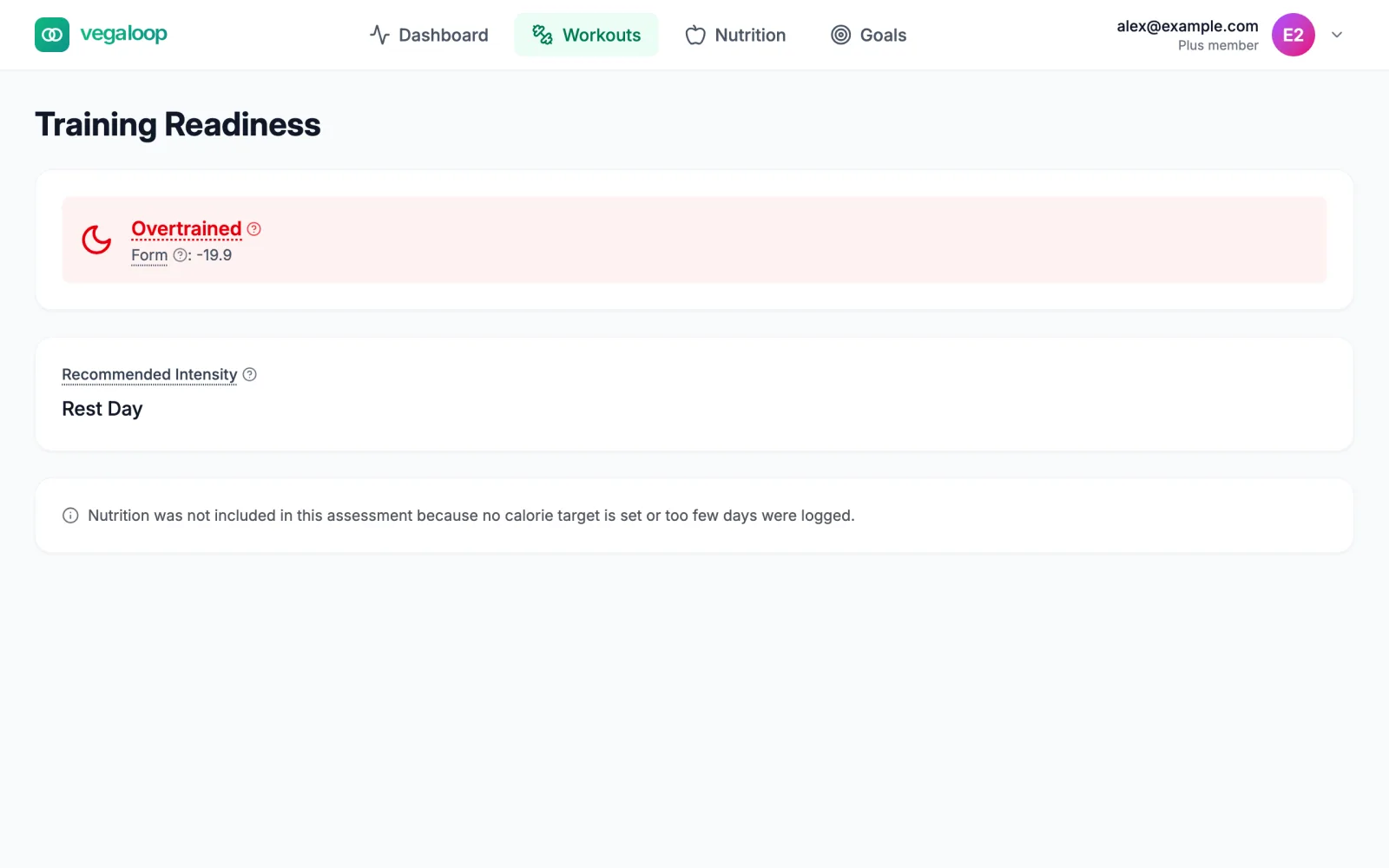
| Level | Recommended intensity | What it means |
|---|---|---|
| Fresh | High | Fitness is well above fatigue. A strong day for a hard session. |
| Ready | High | Balanced load. Train as planned. |
| Neutral | Moderate | Steady state. |
| Fatigued | Low / Recovery | Fatigue is ahead of fitness, which is normal in a build. |
| Overtrained | Rest Day | Load is well beyond your usual level. |
The level comes from form, which is fitness minus fatigue: above 15 is Fresh, 5 to 15 Ready, minus 5 to 5 Neutral, minus 15 to minus 5 Fatigued, below minus 15 Overtrained. Two adjustments can lower the recommendation by a step: a week more than 10 percent above the last, and three days of eating more than 20 percent under target.
The recommended intensity is a guide. If your plan has a key session and you are Neutral, do it. If you are Fatigued for several days in a row, more sleep and more food usually help more than a harder workout. On Plus, VegaLoop makes the change for you with a suggestion card when the check-in agrees.
Training load: fitness, fatigue, and form
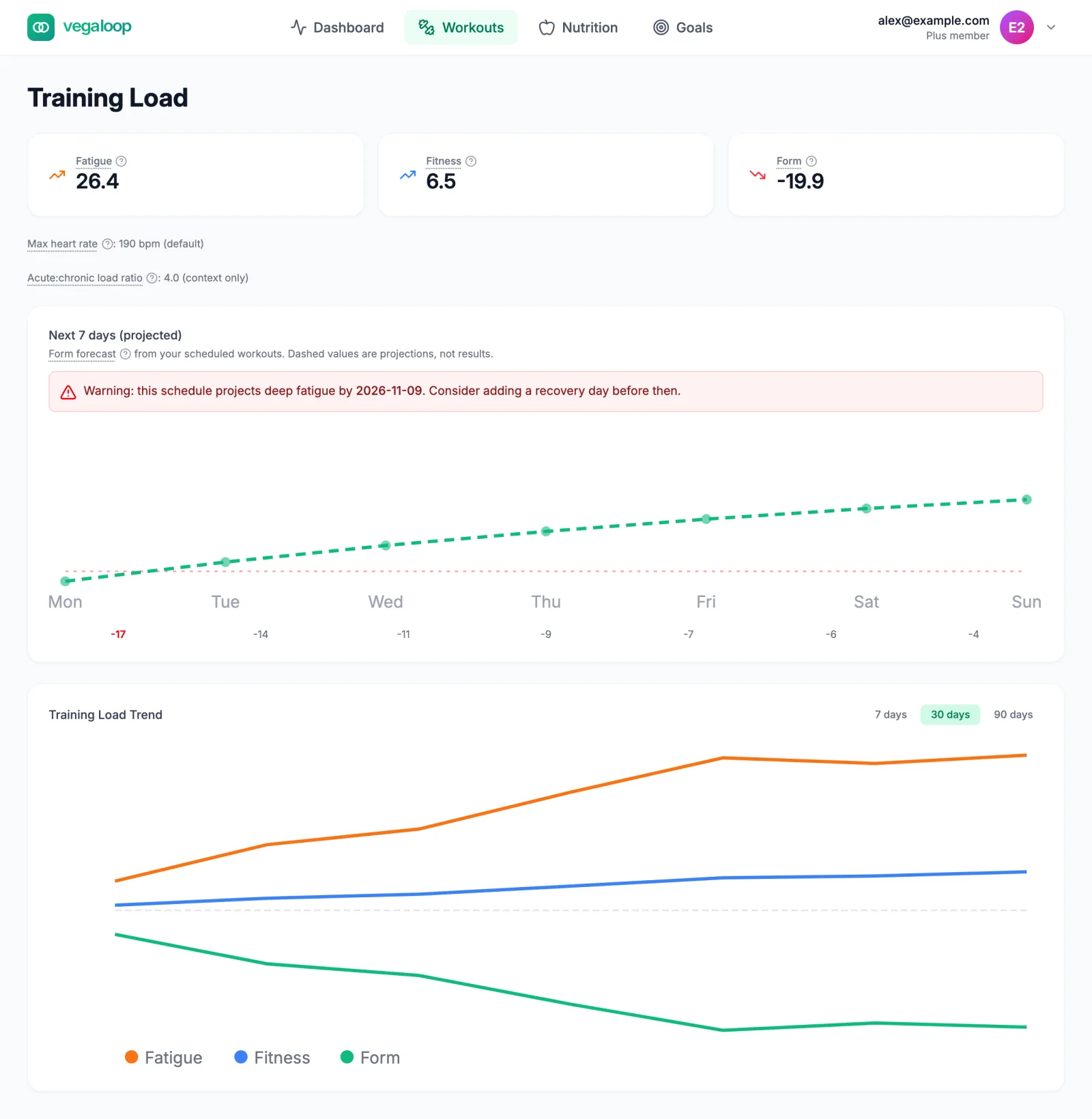
- Fitness rises slowly with consistent training over about six weeks.
- Fatigue rises fast with hard days and falls fast with easy ones, over about a week.
- Form is the difference. Positive form means you are fresh; negative form means you are carrying fatigue.
A hard training block is meant to push form negative. Plan easier days before an event so form recovers while fitness stays. The 7-day projection on the Training Load page shows the form your scheduled sessions will produce; see Training load and readiness.
The breakdown
The dashboard’s readiness breakdown scores each signal on its own: heart rate variability and resting heart rate, sleep, fuel, hydration, load, and activity. A signal without data is left out rather than guessed, and the card says how many it had. Two people with the same form can read differently here because one wears a ring at night and logs meals and the other does not.
What it uses
- Sleep and heart rate variability from a watch or ring have the largest effect.
- Meals logged most days give the nutrition adjustment the data it needs.
- A correct max heart rate on your profile keeps load accurate.
- The morning check-in adds what no device measures; see Check in every morning.